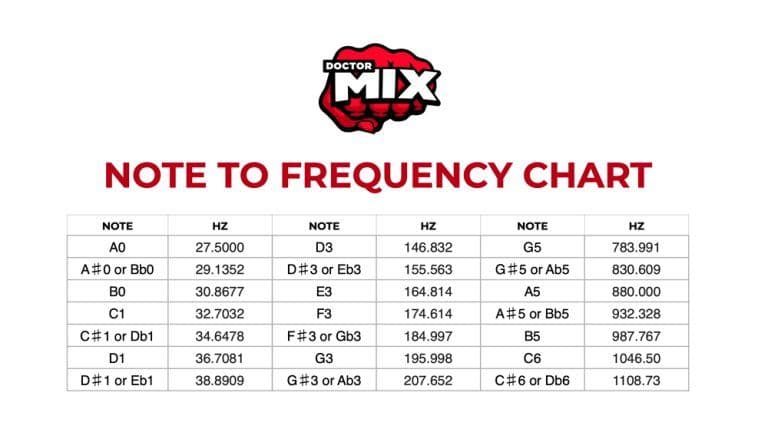
One of the most powerful – and most overlooked – tools in a mixer’s arsenal is the Note to Frequency Chart. If you’ve ever wondered why your kick and bass clash, why a synth pad sounds muddy in a certain key, or how to EQ with musical intention, this chart is the answer.
What Is a Note to Frequency Chart?
A Note to Frequency Chart maps every musical note to its exact frequency in Hz. The piano keyboard spans from A0 (27.5 Hz) at the low end to C8 (4,186 Hz) at the top – and every note in between has a precise frequency that your EQ, synth tuning, or compressor sidechain can target.
This isn’t just music theory. It’s one of the most practical tools in professional mixing and music production.
How to Use the Note to Frequency Chart When Mixing
1. Tune Your Kick Drum to the Key of the Track
If your track is in the key of F minor, the tonal center is F. F2 sits at 87.3 Hz. Tuning your kick’s fundamental to that frequency (or a harmonic of it, like F1 at 43.65 Hz) creates a kick that feels “locked in” to the music rather than fighting it. This is one of the first things professional mix engineers do on any dance or electronic track.
2. Prevent Kick and Bass Clashing
The most common low-end problem in a mix: the kick and bass bass are both fighting for the same frequency. Use the chart to identify the fundamental note of each, then decide which one “owns” that frequency. Many engineers use EQ to cut the bass slightly at the kick’s fundamental, and vice versa – creating space for both to breathe.
3. Surgical EQ on Problem Notes
Got a resonant note on a guitar, piano, or synth? Instead of sweeping blindly through frequencies, use the chart. If the track is in G major and you’re hearing a problem resonance, check G2 (98 Hz), G3 (196 Hz), and G4 (392 Hz) – resonances almost always fall on notes, not random frequencies.
4. Tune Synth Pads and Basslines
When layering synth pads or bass sounds, use the chart to ensure they’re tuned to the correct fundamental. A pad tuned to C3 (130.8 Hz) in a song in C minor will sit perfectly in the harmonic spectrum. Even a few cents off can create unwanted beating between layers.
5. Set Sidechain Frequencies
When using multiband compression or a frequency-specific sidechain, use the chart to set the crossover points musically. If your bass is playing root notes at C2 (65.4 Hz), you might want your sidechain to trigger on everything below 80 Hz – right between C2 and D2 – to keep the low end controlled without over-compressing the mid-bass.
The Note to Frequency Chart
Below is the full note-to-frequency reference chart, covering the complete range of the piano. Bookmark this page – you’ll use it constantly.
Key Frequencies Every Producer Should Memorise
You don’t need to memorise the whole chart – just these anchors, and you’ll always know where you are:
- A4 = 440 Hz – concert pitch, the tuning standard for all instruments
- Middle C (C4) = 261.6 Hz – the centre of the piano keyboard
- C1 = 32.7 Hz – sub-bass territory, felt more than heard
- C2 = 65.4 Hz – deep bass, typical root note for electronic bass sounds
- C3 = 130.8 Hz – mid-bass, where many bass guitars sit
- C5 = 523.3 Hz – upper midrange, where vowel sounds and vocal presence live
- A5 = 880 Hz – the harmonic overtone of concert A, important for string brightness
Pro Tip: Use This Chart With Your EQ
Next time you’re reaching for a narrow EQ boost or cut, don’t just sweep – identify the note first. Ask yourself: “What note am I in, and what’s its frequency?” Then target that frequency intentionally. Your mixes will immediately start sounding more musical and less surgical.
This is how world-class engineers think about EQ – not as a technical correction tool, but as a musical instrument. The Note to Frequency Chart is the bridge between music theory and audio engineering.
Get More Tips Like This
Join the Doctor Mix mailing list — production tips, new tutorials, exclusive offers. No spam, unsubscribe anytime.